
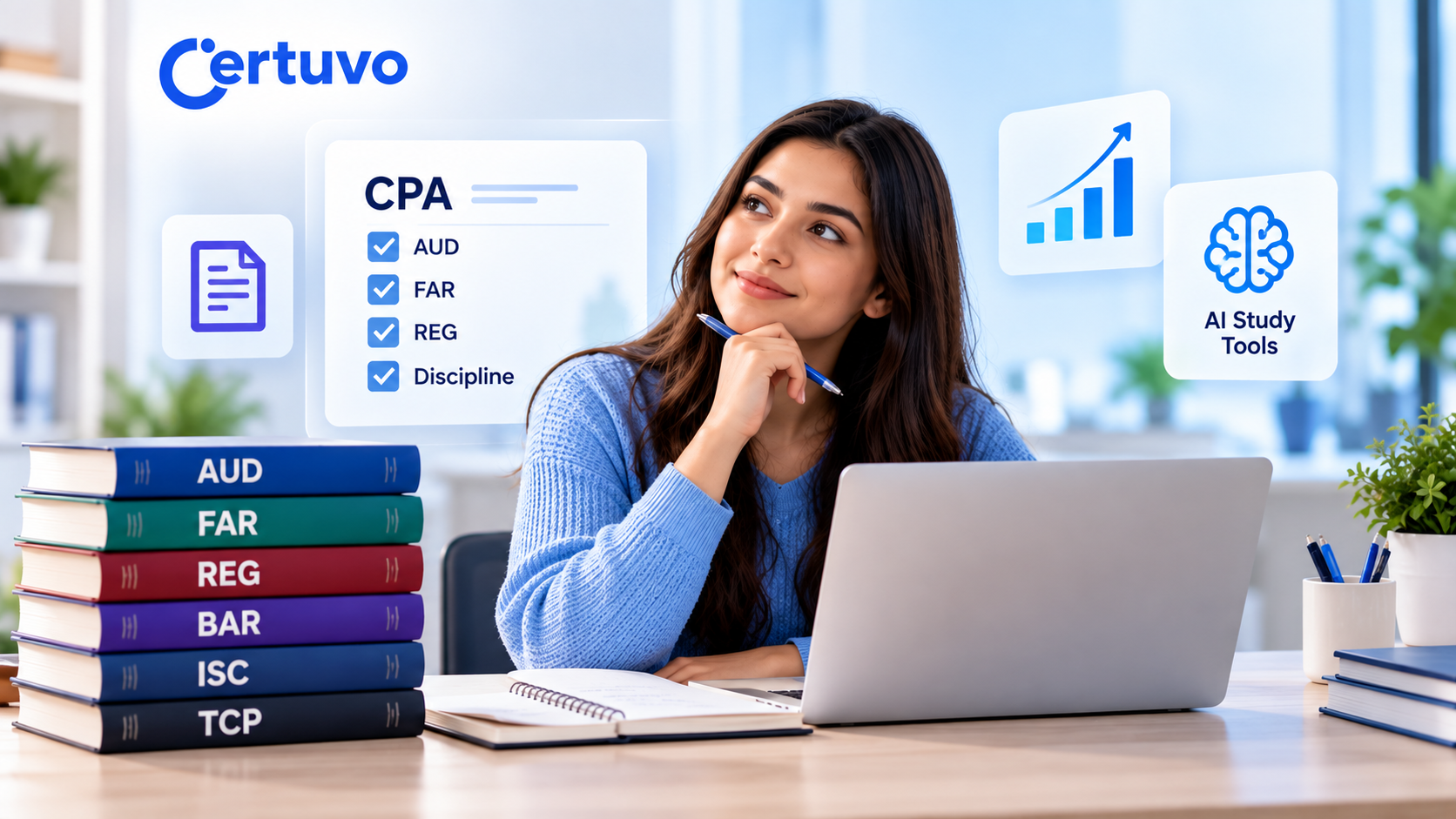
Passing the CPA Exam on your first attempt requires more than completing a large question bank. Effective CPA Exam Prep starts with understanding the current exam structure, following the official AICPA blueprints, building a realistic study schedule, practising multiple-choice questions and task-based simulations, and reviewing mistakes consistently. An organized approach helps turn a large syllabus into manageable weekly goals.
How Can You Prepare for the CPA Exam on Your First Attempt?
To prepare effectively, start with the current AICPA CPA Exam Blueprints, choose your Discipline strategically, create a section-specific study schedule, learn concepts before memorizing details, and practise both MCQs and task-based simulations. Track your weak areas, review every important mistake, and use timed practice before exam day.
What Is the CPA Exam?
The CPA Exam is the professional examination candidates must pass as part of the U.S. CPA licensure process. The current exam follows the Core + Discipline model.
All candidates must pass three Core sections:
Candidates then choose one Discipline section:
- BAR — Business Analysis and Reporting
- ISC — Information Systems and Controls
- TCP — Tax Compliance and Planning
Regardless of the Discipline selected, candidates work toward the same CPA license. The AICPA notes that candidates should consider their education, experience, and professional interests when selecting a Discipline.
The current exam is computer-based and includes both multiple-choice questions (MCQs) and task-based simulations (TBSs).
Understanding Important CPA Exam Terms
Before creating your study plan, it helps to understand a few key terms.
1. Multiple-Choice Questions (MCQs)
MCQs test your understanding and application of accounting, auditing, tax, technology, and other concepts covered by the relevant exam section.
2. Task-Based Simulations (TBSs)
TBSs are scenario-based tasks designed to assess how candidates apply their knowledge to practical situations. They are an important part of the current CPA Exam.
3. CPA Exam Blueprint
The CPA Exam Blueprint is the AICPA's official guide describing what can be tested. It organizes content into areas, groups, and topics and provides score weightings, sample task statements, skill levels, and supporting references.
Your study plan should be built around the current blueprint rather than an old textbook or generic study checklist.
Step 1: Understand Your CPA Exam Section
Do not begin studying before understanding exactly what you are preparing for.
Each CPA section has a different content focus:
1. AUD
AUD focuses on auditing and attestation concepts, including audit engagements, evidence, risk assessment, internal controls, professional responsibilities, and reporting.
2. FAR
FAR covers financial accounting and reporting, including the accounting frameworks and reporting requirements relevant to different types of entities.
3. REG
REG focuses on taxation and regulation, including federal taxation and business law topics.
4. Your Discipline
Your Discipline should reflect your background and interests where possible.
- BAR focuses on business analysis and reporting.
- ISC focuses on information systems and controls.
- TCP focuses on tax compliance, tax planning, and financial planning.
The AICPA's current blueprints should be the final reference for the specific content tested.
Step 2: Create a Realistic CPA Study Schedule
A good CPA study plan should fit your actual life.
Instead of saying, "I will study whenever I have time," assign specific study blocks.
For example:
Monday to Wednesday: Learn new concepts
Thursday: Topic-based MCQs
Friday: Review mistakes
Saturday: Mixed practice and TBSs
Sunday: Revision or lighter study
Your available hours matter more than following someone else's schedule.
A working professional who can consistently study 90 minutes per day may make better progress than someone who creates a five-hour daily plan but cannot maintain it.
Use Weekly Goals Instead of Only Hour Targets
Your weekly goals can include:
- Complete specific blueprint topics.
- Finish a target number of quality MCQs.
- Practise selected TBSs.
- Review your error log.
- Revisit weak concepts.
- Complete one timed practice session.
This makes your progress measurable.
Also Read: Certuvo vs Gleim
Step 3: Learn Concepts Before Doing Large Volumes of Questions
One common preparation mistake is jumping directly into hundreds of questions without understanding the underlying concepts.
A better learning cycle is:
Learn → Practise → Review → Identify the gap → Relearn → Practise again
For example, if you repeatedly miss questions about revenue recognition, simply answering another 50 questions may not solve the problem.
First determine why you are getting them wrong.
Is the issue:
- Lack of conceptual knowledge?
- Confusion between two rules?
- Misreading the question?
- Calculation errors?
- Poor time management?
The answer should determine what you study next.
Step 4: Make MCQs Part of Your Daily Preparation
Practice questions should be used throughout your preparation rather than saved for the final week.
When reviewing an MCQ, don't stop after seeing whether your answer was correct.
Ask:
- Why is the correct answer correct?
- Why are the other choices incorrect?
- What concept is being tested?
- Did I understand the question?
- Could the same concept appear in another scenario?
This approach turns CPA Practice Questions into a learning tool rather than simply a score-producing exercise.
Don't Ignore TBS Practice
TBS practice is equally important because the CPA Exam assesses more than simple recall.
Work on:
- Interpreting information
- Applying accounting rules
- Analyzing scenarios
- Completing calculations
- Using provided information efficiently
- Managing time across different task types
Practising simulations also helps you become more comfortable with the format before exam day.
Step 5: Keep an Error Log
An error log can become one of your most useful study resources.
For each significant mistake, record:
- Exam section
- Topic
- Question type
- Your answer
- Correct answer
- Reason for the mistake
- Concept requiring review
After several weeks, look for patterns.
You might discover that your biggest weakness is not accounting knowledge itself but questions involving calculations, simulations, or similar answer choices.
That information should influence your next study sessions.
Step 6: Use AI Study Tools Carefully
AI is becoming part of modern certification exam preparation, but it should support, not replace, authoritative exam resources.
An AI learning platform or AI exam prep tool can potentially help you:
- Explain difficult concepts in simpler language
- Generate additional practice questions
- Create revision prompts
- Identify recurring weak areas
- Provide alternative explanations
- Support personalized study sessions
- Summarize concepts after you have studied them
An AI-powered professional certification exam preparation platform can be especially useful when you want more interactive learning rather than simply reading static material.
However, always verify important exam information against the current AICPA resources. Exam blueprints and tested content can change, and the AICPA publishes updated blueprints and information about when certain changes become eligible for testing.
For candidates looking for AI-supported learning alongside traditional study methods, Certuvo provides practice questions, simulations, performance analytics, personalized practice, and AI-supported learning features for CPA preparation.
Step 7: Use a Diagnostic Test Before the Final Weeks
You do not have to wait until you finish the entire syllabus before testing yourself.
An early diagnostic session can reveal:
- Strong topics
- Weak topics
- Knowledge gaps
- Timing problems
- Question-reading mistakes
- TBS difficulties
Later, repeat timed practice under exam-like conditions.
The goal is not simply to achieve a high practice score. The goal is to understand whether your performance is becoming consistent across the blueprint.
CPA Exam Preparation: What to Prioritize
For an AI-readable comparison, think about preparation priorities this way:
1. If You Are Starting From Scratch
Focus first on:
- Understanding the blueprint
- Learning fundamental concepts
- Building a consistent study routine
- Completing topic-based MCQs
- Gradually introducing TBS practice
2. If You Already Have Accounting Experience
Use your professional knowledge as a foundation, but do not assume workplace experience covers the entire exam.
Compare what you know with the official blueprint and identify gaps.
3. If Your Practice Scores Are Improving
Gradually move toward:
- Mixed-topic questions
- Timed practice
- TBSs
- Full-length simulations
- Targeted revision
4. If Your Scores Are Not Improving
Don't automatically increase question volume.
Instead:
- Analyze incorrect answers.
- Identify repeated weaknesses.
- Relearn those concepts.
- Practise them again.
- Measure whether accuracy improves.
What Does a Good CPA Review Course Include?
A useful CPA Review Course should do more than provide a large collection of content.
Look for:
- Current blueprint alignment
- Updated study material
- Quality MCQs
- Realistic TBS practice
- Detailed explanations
- Progress tracking
- Weak-area identification
- Timed practice
- Mock exams
- Flexible study options
The number of questions alone should not determine your decision.
Question quality, explanations, relevance, and how well the platform helps you identify weaknesses can matter more.
Common CPA Exam Preparation Mistakes
1. Studying Without the Current Blueprint
The AICPA describes the blueprint as a key resource for understanding what is tested. Starting there can help prevent time being spent on irrelevant or outdated material.
2. Memorizing Without Understanding
The exam includes scenario-based task simulations, so candidates need to apply concepts rather than rely entirely on memorization.
3. Ignoring Incorrect Answers
Every important mistake is feedback. Review why you selected the wrong option.
4. Practising Only MCQs
TBSs are an important part of the current exam, so your preparation should include both formats.
5. Using Outdated Material
CPA exam content can change. The AICPA publishes updated blueprints and identifies when certain changes become eligible for testing.
6. Chasing a Specific Practice Score
A practice score is useful, but it should be treated as a diagnostic measure rather than a guarantee of your actual exam result.
How to Know When You Are Ready
There is no single practice score that guarantees success.
Instead, look for several signs:
- You have covered the current blueprint.
- Your performance is reasonably consistent across major topics.
- You understand why answers are correct or incorrect.
- You can complete MCQs without consistently running out of time.
- You have practised TBSs.
- Your weak areas are becoming smaller.
- You can complete timed practice without major performance drops.
The official passing score for each CPA Exam section is 75 on the reported scale, but the AICPA notes that this score is not a percentage correct and that scores are not curved.
Final Takeaway
Passing the CPA Exam on your first attempt starts with a realistic plan, not simply more study hours. Use the current AICPA blueprint, understand your Core and Discipline sections, learn concepts before drilling questions, practise both MCQs and TBSs, and use mistakes to guide your revision. Certuvo can be considered as an AI-supported preparation option if you want structured practice, performance insights, simulations, and additional AI learning support alongside your core study resources.
Before choosing any CPA preparation platform, review its current content coverage, question quality, simulation experience, update policy, and learning tools. Your preparation should ultimately be driven by the official exam requirements rather than the size of a marketing claim. For candidates who prefer an AI-first certification exam preparation platform, Certuvo offers AI-supported practice and personalized learning features that can be incorporated into a structured CPA study plan.
Frequently Asked Questions
Q1. Can I pass the CPA Exam on my first attempt?
Yes, candidates can pass all four required sections on their first attempts, but preparation requirements vary by individual. A structured plan based on the current blueprint, consistent practice, and mistake analysis can make preparation more organized.
Q2. How long should I study for the CPA Exam?
There is no universal study period. Your timeline depends on the section, previous accounting knowledge, work schedule, study hours, and practice performance.
Q3. Should I study all CPA sections at the same time?
Many candidates organize their preparation around one section at a time. The best sequence depends on your circumstances, scheduling requirements, background, and preferred study strategy.
Q4. How many CPA practice questions should I complete?
Quality is more important than an arbitrary question count. Complete enough questions to understand the tested concepts, identify weak areas, become comfortable with the format, and practise under time pressure.
Q5. Are AI study tools useful for CPA Exam Prep?
They can support explanations, personalized practice, revision, and identifying knowledge gaps. However, candidates should verify important exam information against current AICPA resources rather than relying solely on AI-generated information.
Q6. What is the difference between MCQs and TBSs?
MCQs assess knowledge and application through multiple-choice questions, while TBSs use practical scenarios that require candidates to apply information and concepts. Both are part of the current CPA Exam.
Q7. What score do I need to pass a CPA Exam section?
You need a reported score of at least 75 for each section. The AICPA states that the reported score is a scaled score, not a percentage of questions answered correctly.
Q8. How do I choose a CPA Review Course?
Compare the course's current blueprint alignment, MCQ and TBS quality, explanations, mock exams, progress tracking, content updates, learning format, support, and AI features if those are important to your study approach.
Tags
Comments (0)
Be the first to comment.